Hari Sarvothama Vayu Jeevothama
Sri Purandara Dasaru (1480–1564)
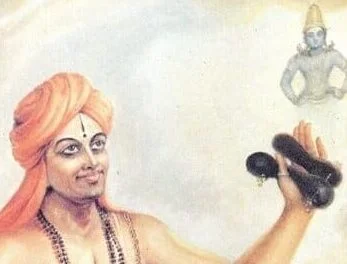
Sri Purandara Dasaru, revered as Daasa Shreshtha (the greatest among devotees) and Dayanidhi (treasure of compassion), was a foremost saint-composer who spread the core teachings of Sri Madhvacharya’s Dvaita philosophy through his Keertanas, Suladis, and Uga Bhogas.
A disciple of Sri Vyasarajaru, Purandara Dasaru is said to have composed about 4,75,000 devotional songs in praise of Lord Vasudeva, with his guru’s blessings. Vyasarajaru, deeply moved by the spiritual depth of these compositions, placed them near his Vyasa Peetha and called them the “Purandara Upanishad” — not merely for their vast number, but because each song embodied the essence of the Upanishads.
Before his transformation into a saint, Purandara Dasaru was a learned Sanskrit scholar who attained spiritual initiation (Deeksha) and divine vision under his guru’s guidance. His humility and devotion to both Guru and Hari remain exemplary.
Sadly, due to historical losses such as the destruction of the Vijayanagara Empire and foreign invasions, only a few thousand of his compositions survive today. Had the complete collection remained, the Kannada language — already central to Carnatic music because of him — would have shone even brighter across India.
The passage also laments that in states like Tamil Nadu and Andhra Pradesh, new students of Carnatic music are rarely introduced to the works of saints like Purandara Dasa, Kanaka Dasa, and Vijayadasa. It calls for a revival of this tradition, reminding that the term “Carnatic” itself originates from Karnataka, thanks to the legacy of Purandara Dasaru, the true father of Carnatic music.
Pearls of Sri Purandara Dasa – 1
To honour our great saint and bring his divine wisdom to a wider audience, I will be posting each song of Sri Purandara Dasaru — along with its English translation and meaning — as a dedicated series on my website.
Through this ongoing series, readers can experience the devotion, philosophy, and poetic beauty of Purandara Dasa’s compositions, one song at a time. Thanks to karnatik.com for lyrics, they have got very good collections.
AcAravillade nAlige
raagam: kAmbhOjitaaLam: jhampe
Aa:S R2 G3 M1 P D2 S
Av: S N2 D2 P M1 G3 R2 S N3 P D2 Spallavi
AcAravillade nAlige ninna nIca buddhiya biDu nAlige
anupallavi
vicAravillade parara dUSipudakke cAci koNdiruvantha nAlige
caraNam 1
prAtakkAladoLeddu nAlige siri patiyenna bArade nAlige
patita pAvana namma rajapati janakana satatavu nuDi kaNDya nAligecaraNam 2
cATi Elalu bEDa nAlige ninna bEDikombuvenu nAlige
rUDhikoDeya shrI rAmana nAmava pADutaliru kaNDya nAligecaraNam 3
hari smaraNe mADu nAlige narahariya bhajisu kaNDya nAlige
varada purandara viTTala rAyana caraNa kamala nene nAlige
English Meaning:
The song is a heartfelt reminder to the tongue to use its power wisely. It urges one to give up gossip, harsh speech, and idle criticism, and instead to speak and sing only of the Lord. Each verse lovingly guides the tongue toward remembering and praising Vishnu, Rama, and Narahari, and to meditate on the divine feet of Purandara Vittala, the giver of grace. The essence of the song is a call to transform one’s speech into a tool of devotion, purity, and spiritual upliftment.
Disclaimer
I humbly acknowledge that any errors in translation or interpretation are solely mine, arising from my limited understanding.
With utmost devotion, I submit all these efforts — along with their imperfections — at the sacred feet of the Lord Sriman Narayana, and Sri Purandara Dasaru. May Lord forgive my mistakes and bless this humble attempt to share Sri Purandara Dasaru’s message with the world.
~Sri Krishnaarpanamasthu~
About The Author
